

BOOK REVIEW:
Why This Book Lands Right Now
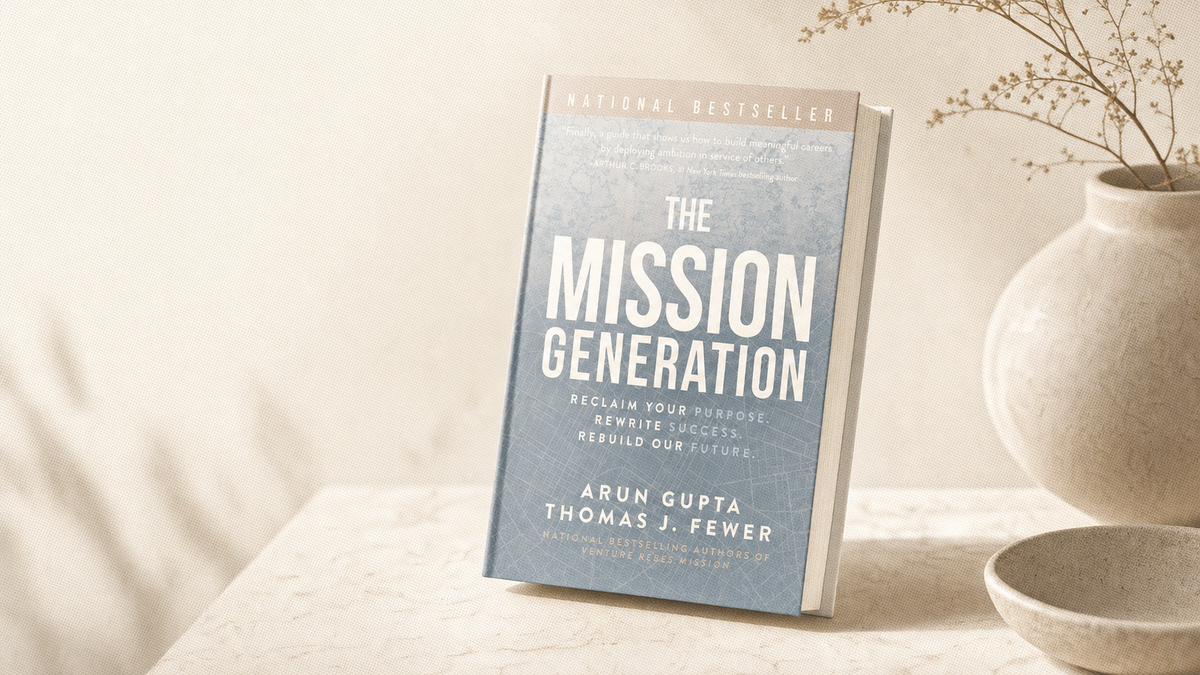
At a moment when AI is rewriting job descriptions faster than most companies can update org charts, when geopolitical instability is reshaping entire industries overnight, and when a generation of talented people are quietly asking whether their work actually matters — The Mission Generation arrives as a rigorous, hopeful, and disarmingly practical answer.
Co-authored by Arun Gupta — Venture Capitalist, CEO of the NobleReach Foundation, Stanford lecturer, and Georgetown entrepreneurship professor — and Dr. Thomas J. Fewer of Rutgers University, the book is the intellectual successor to their national bestseller Venture Meets Mission (2024). Where that earlier volume showed how entrepreneurs, investors, and public leaders could align innovation with civic purpose, The Mission Generation zooms in on the individual: it hands the reader a compass, not a map, and teaches them how to use it.
The book carries endorsements from Harvard's Arthur C. Brooks, Accenture CEO Julie Sweet, ASU President Michael Crow, former Commerce Secretary Gina Raimondo, and U.S. Space Force General John Raymond — a cross-sector roll call that signals this is not a conventional career self-help book.
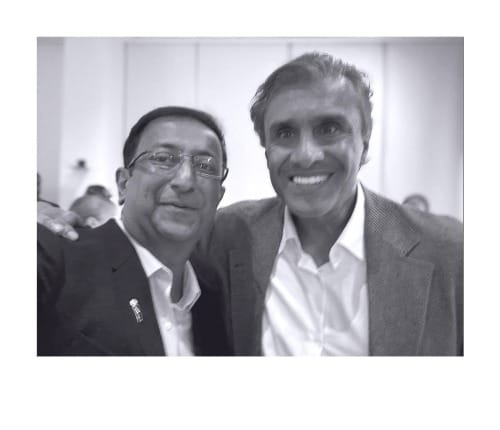
A personal note: I had the good fortune of meeting Arun at one of the book's launch events and hearing him speak live again at the TiE DC FedGov Symposium on June 17, 2026 — where Sumeet Shrivastava, President & CEO of Unissant, interviewed Arun alongside Justin Fanelli, CTO of the Department of the Navy, about the book and the broader talent crisis reshaping government and industry. What struck me most in that room was not a rehearsed talking point but the unmistakable conviction of someone who has lived these ideas across eighteen years of venture investing, government advising, and institution-building. The frameworks in this book are not theorized from the sidelines — they are field-tested.
I'll admit, the book hit close to home. My own career has been anything but linear — from hardcore programmer and technologist, to entrepreneur and operator, to venture capitalist managing a portfolio of deep-tech and defense investments. Each chapter seemed radically different at the time. In hindsight, it was one compounding arc. Gupta and Fewer have a framework for that — and they'd probably call it exactly what it was: Compass Capital at work.
The Central Argument: Stability Is the New Risk
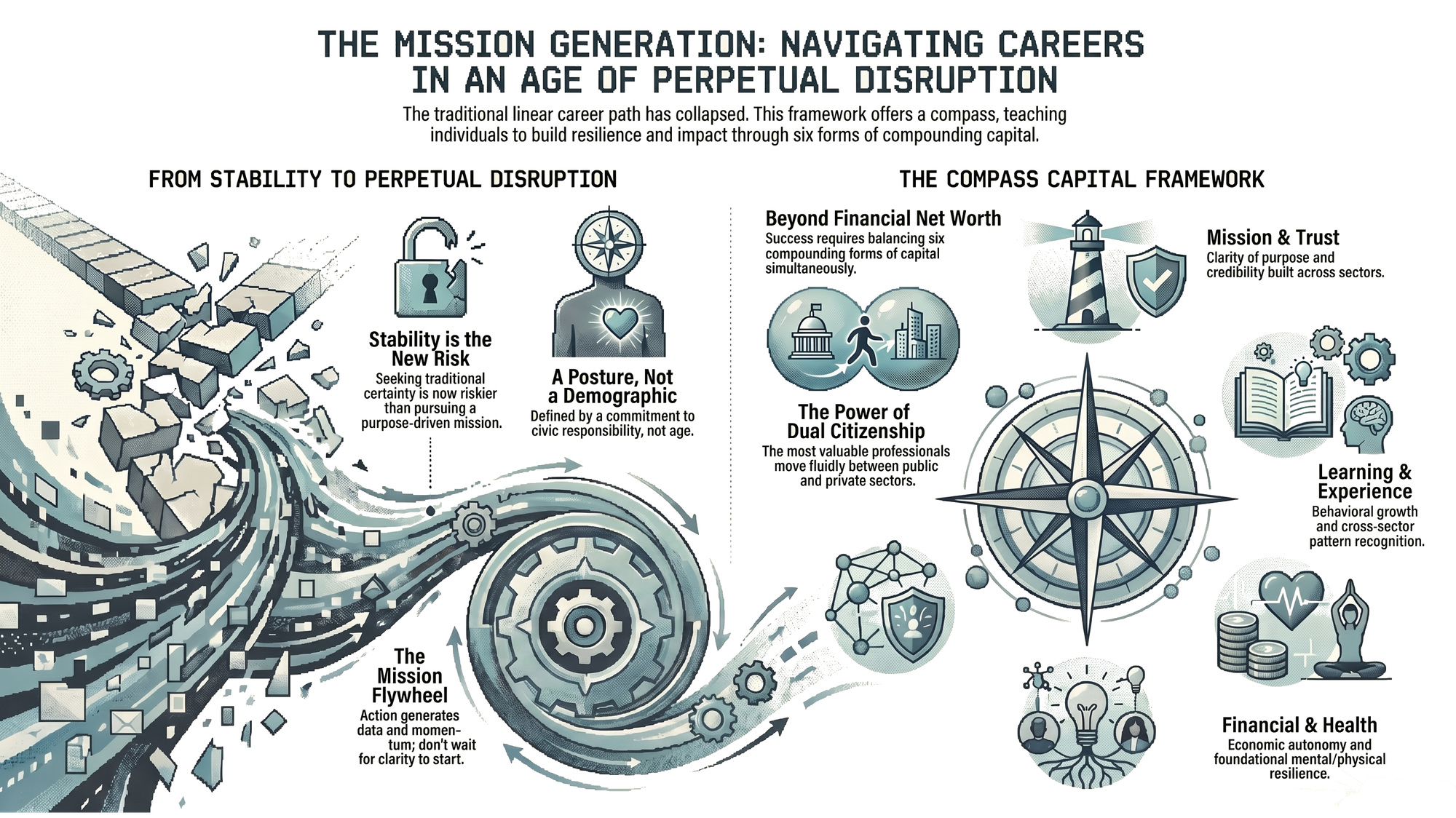
The book's most provocative claim is also its most empirically grounded: the traditional career playbook — pick a field, climb a ladder, retire — has structurally collapsed.
Gupta's own framing is blunt: "My dad had one job for 40 years. I had one career. Going forward, kids are going to have four to six careers."
The forces driving this collapse are not cyclical. They are structural. Artificial intelligence is automating entire categories of cognitive work. Geopolitical conflict is fragmenting supply chains and reordering national priorities. Ecological stress is displacing entire industries. Political polarization is eroding institutional trust. These are not isolated shocks — they are what Gupta and Fewer call tectonic shifts that are permanently redefining the nature of work.
Their counterintuitive insight: in a world of perpetual disruption, searching for stability is itself the highest-risk strategy. "Stability is the new risk," Gupta argues. "Searching for stability is riskier than finding what you really care about and going and doing it." The book reframes that loss of career certainty not as a crisis but as an invitation — to build something more durable than a job title: a mission.
What Is "The Mission Generation"?
The title is deliberately not a demographic label. Gupta is emphatic: the Mission Generation is a posture, not an age group. Boomers, Gen X, Millennials, and Gen Z can all belong to it. What unites them is a refusal to accept broken systems and a commitment to combining personal ambition with civic responsibility.
This distinction matters because it sidesteps the tired generational blame game. Gupta is not claiming that young people are uniquely idealistic or that older professionals are cynically self-interested. He is arguing that the conditions of the present moment — AI disruption, institutional fragility, compressed global crises — have created a shared hunger for work that means something, regardless of decade of birth. "People were all searching for the same thing, and that was purpose," he observes.
The Three-Part Architecture of the Book
The Mission Generation is structured across three thematic arcs, each designed to move the reader from diagnosis to action:
Part I: Welcome to Perpetual Disruption
The opening section establishes the landscape. Gupta and Fewer diagnose the collapse of the traditional career contract — the once-reliable compact between employer and employee that promised stability in exchange for loyalty. They document how institutions (public, academic, and corporate) are fracturing under compounding pressure, and why the old maps no longer describe the terrain.
A critical thread here is the reframing of how people measure career success. The authors argue that we have been using a dangerously narrow definition of net worth — one that collapses everything into a bank balance — while ignoring the forms of capital that actually sustain a meaningful life over time. This critique sets up the book's central framework.
Part II: Compass Capital — Your True Competitive Advantage
The intellectual heart of the book is the Compass Capital framework: six forms of capital that, when developed in parallel, compound to create careers of lasting impact, even in volatile conditions. These six are:
| Capital | What It Represents |
|---|---|
| Mission Capital | Clarity of purpose — the why that anchors all decisions |
| Financial Capital | The economic engine that buys autonomy and optionality |
| Trust Capital | Relationships and credibility built across sectors and time |
| Learning Capital | The behavioral commitment to curiosity and growth that outlasts any disruption |
| Experience Capital | Cross-sector exposure that generates pattern recognition and judgment |
| Health Capital | Physical and mental resilience as a foundational career asset |
The insight is not that financial capital is irrelevant — Gupta is, after all, a venture capitalist who spent eighteen years as a partner at Columbia Capital investing in cybersecurity, national security AI, and government technology. The insight is that financial capital alone is insufficient and, when it crowds out the others, becomes a liability. The book's subtitle — Reclaim Your Purpose. Rewrite Success. Rebuild Our Future. — is essentially a call to hold all six forms of capital in view simultaneously.
A standout concept is Trust Capital, which Gupta describes as "the most valuable asset you'll never own." In an era defined by institutional distrust and sector silos, the ability to earn credibility across government, industry, academia, and civil society becomes a genuine strategic advantage — not a soft skill but a hard currency.
The Dual Citizenship Metaphor. One of the book's most resonant ideas is the notion of becoming a dual citizen of the public and private sectors. Rather than forcing a binary choice between a lucrative tech career and a meaningful public service career, Gupta and Fewer argue for building careers that move fluidly between both. This is precisely what makes cross-sector professionals so valuable at a moment when the problems are no longer siloed but the talent still is.
Part III: The Four Resistances and the Mission Flywheel
The final arc is the most operationally useful. Having defined what meaningful work looks like and what it's built from, the book turns to the question of why so few people actually pursue it — and how to overcome that inertia.
The Four Resistances
Arun Gupta and Thomas J. Fewer identify four structural barriers that block talented people from pursuing purposeful work — and why most career advice never addresses them.
The internal critic that questions whether you are capable, credentialed, or deserving enough to pursue something larger. The book addresses this with a chapter on summoning the courage to be wrong.
Social pressure, peer comparison, and institutional prestige quietly lock people into paths they never consciously chose. The authors are pointed in their critique of higher education's drift toward credentialism at the expense of genuine discovery.
The absence of allies, mentors, and community for people who are early movers on unconventional paths. The book offers a framework for recruiting people who will:
"hold the rope while you jump."
The structural mismatch between how institutions hire and reward talent and what purpose-driven professionals actually need.
"Government is selling careers — young people are buying experiences."
The Mission Flywheel. Rather than advocating for a grand, pre-planned life redesign, Gupta and Fewer introduce the Mission Flywheel — a model that begins with small, strategic actions and builds momentum through iteration. The logic is anti-perfectionist and deeply entrepreneurial: don't wait for clarity before acting. "You can't wait for clarity to take action. By the time you get clarity the old way, the conditions have already changed."
The flywheel reframes breakthrough not as a singular moment but as "a thousand small ones" — a compound effect of consistent, purpose-driven choices that reinforce each other over time. For anyone who has built a company, invested in a startup, or navigated a complex fund structure, the logic will feel immediately familiar: conviction precedes clarity, action generates data, and momentum is built, not found.
Why This Resonates Beyond Career Advice
The Mission Generation is ultimately a book about the architecture of ambition in an age of disruption — and that is what distinguishes it from the crowded shelf of purpose-driven career books.
Gupta and Fewer do not ask readers to sacrifice financial success for meaning. They argue the opposite: that mission is the competitive advantage. The most resilient professionals, the most cohesive teams, and the most enduring institutions are those in which personal ambition and civic responsibility point in the same direction. This is not idealism — it is what the data on high-performing companies and the lived experience of cross-sector leaders consistently shows.
For operators building at the intersection of AI, venture capital, and national purpose — the exact terrain Opulentia navigates — the book's frameworks land with particular force. The Compass Capital model maps directly onto how sophisticated investors already think about portfolio construction: diversified, compounding, rebalanced over time. The dual citizenship metaphor describes exactly the cross-sector fluency that will define the most consequential operators of the next decade.
As Arthur C. Brooks writes in his endorsement: "Finally, we have a guide that shows us how to do it. Read The Mission Generation to deploy your ambition in service of others."
The Authors
Disclaimer: This blog post is a personal review and commentary on Arun Gupta's book “The Mission Generation.” All insights, historical narratives, and analyses discussed are drawn from Gupta's research and work.
Buy your own copy of the book here.
About Opulentia Ventures
Opulentia Ventures operates as a “VC Tribe” consolidating resources from experienced investors to support pioneering companies advancing technology, healthcare, and national security. Headquartered in the Washington, DC, metro area, the firm leverages deep government and defense-sector relationships to identify emerging opportunities at the intersection of innovation and national priorities. Opulentia’s investment architecture is organized into four domain-focused pillars: Valkyrie, backing defense technology and dual-use systems that strengthen deterrence and operational advantage; Cipher, targeting deep tech innovations in AI, quantum, and critical infrastructure; Panacea, investing in health technology and life sciences that improve care delivery and population resilience; and Aether, focused on space and energy platforms building the next generation of orbital and terrestrial infrastructure.