

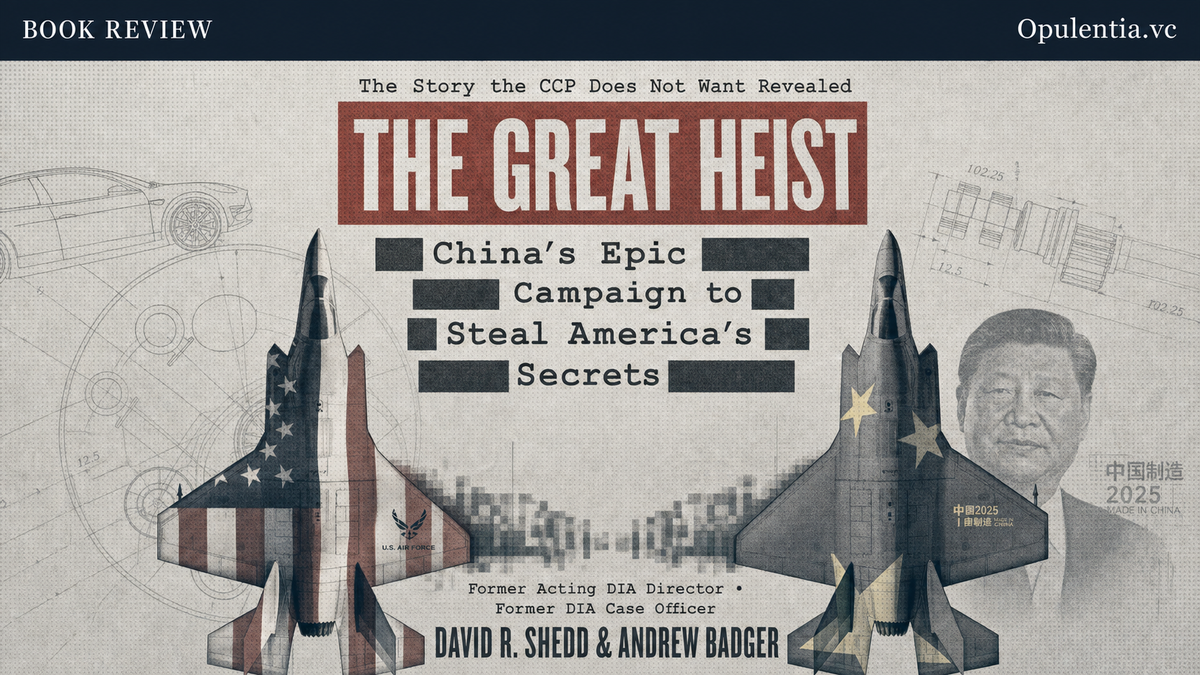
How This Review Came to Be
Some books find you. Others, you have to be in the right room at the right moment to discover.
It was at the NVTC Annual Meeting on June 25, 2026, that I first heard David R. Shedd speak in person. As a member of the NVTC Board of Directors, I have had the privilege of attending many extraordinary gatherings of technology and national security leaders — but this one stood apart. Seated across from Jennifer Taylor, NVTC President and CEO, in a fireside chat format, David laid out — calmly and with striking specificity — exactly how China has been systematically dismantling America’s technological edge, one stolen secret at a time. By the end, the room had gone quiet in that particular way that only happens when an audience realizes the scale of something they had previously underestimated.
I walked away with a copy of the book and reached out to David directly for permission to share this review with the Opulentia Tribe. He graciously agreed.
Here is what you need to know.
"The so-called miracle of China's economic progress wasn't the result of enlightened policies from the CCP. Instead, it stemmed from blatant theft on an unprecedented scale within the global economy."
— David R. Shedd & Andrew Badger
Who Is Telling This Story — And Why It Matters
Books about China's rise are not in short supply. What sets The Great Heist apart begins with its authors. David R. Shedd served as the acting director of the Defense Intelligence Agency, was a special assistant to the president for intelligence under George W. Bush, and spent the better part of three decades operating inside the architecture of American national security. His co-author, Andrew Badger, is a former DIA case officer who graduated from the CIA's elite training program known as 'The Farm,' and has since advised firms like McKinsey & Company and Deutsche Bank on geopolitical risk — and lectured on state-sponsored espionage at Oxford.
These are not pundits extrapolating from open-source data. They are practitioners writing from direct experience. When Shedd says he watched Chinese espionage erode American advantage in real time — and that key counterintelligence units were dismantled before the full picture was understood — he is not speculating. That credibility permeates every page of this book and is precisely what makes it worth taking seriously.
The Thesis: Not a Miracle — A Heist
The book's central argument is deceptively simple: China's extraordinary economic rise — the story of hundreds of millions lifted from poverty, fishing villages transformed into megacities, a third-world economy becoming the world's second largest — was not the product of enlightened policy or disciplined industrial planning alone. It was, at its strategic core, engineered by the largest coordinated theft of intellectual property, technology, and data in human history.
The authors call it the 'Great Heist' — a 20- to 30-year covert campaign directed by China's Ministry of State Security (MSS), designed to strip the United States and its allies of their economic, technological, and military edge. The FBI estimates that China steals approximately $600 billion in U.S. intellectual property every single year. Xi Jinping grew China's nominal GDP from $1.3 trillion in 2001 to over $17 trillion today — and, the authors argue, a significant portion of that growth was subsidized by stolen American research and development costs representing trillions of dollars saved since the 1990s.
What makes this book different from prior treatments of Chinese espionage is the connective tissue the authors weave between previously isolated incidents. As Shedd and Badger explain, no one had pulled all of these pieces together into a single, coherent story — and the true magnitude of the operation had gone largely unrecognized. This is not a collection of anecdotes. It is a unified theory.
The Architecture of the Operation
One of the book's most illuminating contributions is its contrast between how Western intelligence services operate versus how the MSS functions. The CIA is selective and focused — it targets high-value assets with precision. The MSS is something else entirely: sprawling, opportunistic, and operating on the law of large numbers. It treats every academic paper, every corporate network, every visiting researcher, and every unwitting business traveler as a potential input into Chinese state power.
This 'whole-of-society' approach is what makes it so difficult to counter with traditional counterintelligence tools. A scientist asking innocent follow-up questions at a conference. A LinkedIn outreach that appears professional. A scholarship recipient is quietly obligated to report on advanced technologies. These are not isolated incidents — they are structural features of a machine built to scale without leaving obvious fingerprints. And unlike Western intelligence services operating under legal and oversight constraints, the MSS operates with no meaningful limits.
The Case Studies That Hit Hardest
The book comes alive through its case studies, and several are genuinely difficult to read — not because they are sensationalized, but because they are so ordinary. Tesla is one of the most instructive. The authors document how insider threats and supply chain vulnerabilities enabled Chinese actors to extract critical EV technology. Elon Musk reportedly dismissed the concern with characteristic bravado: 'They might steal our IP, but we'll innovate faster.' The rebuttal is BYD — now rolling out new models at a pace that has directly eroded Tesla's global market position. Complacency, the authors argue, is not a strategy.
The 2015 Office of Personnel Management breach is the incident that personally radicalized Shedd. Chinese hackers extracted security clearance files on 22 to 23 million Americans — a treasure trove of biographic, financial, psychological, and relational data representing the ultimate foundation for future targeting, blackmail, and recruitment. It was not a one-time intrusion. It was an infrastructure collection, quietly assembled over time for long-term strategic use.
For our community specifically, the book's treatment of Silicon Valley venture capital is the most provocative. PRC-backed funds quietly embedded themselves in early-stage U.S. innovation ecosystems, inadvertently channeling American institutional capital into Chinese technology advancement. This is not an abstract concern — it is a direct challenge to understand the provenance and ultimate beneficiaries of the capital flowing through our ecosystem. And the frontier has moved: today's primary targets are AI model weights, quantum computing algorithms, and next-generation semiconductor architectures. The authors describe AI as the new crown jewel of the heist's next chapter.
What America Let Happen
If the book's diagnosis is damning, its explanation of how America enabled the heist is even more sobering. China's entry into the World Trade Organization in 2001 opened the door at the precise moment policymakers chose to believe that economic integration would inevitably produce political liberalization. That bet proved catastrophically wrong — and it was bipartisan. Key CIA counterintelligence units were shuttered. The China Initiative, a federal program to prosecute economic espionage, was scrapped under political pressure. Corporate America prioritized market access over security. And Made in China 2025 — launched in 2015 as an industrial policy blueprint — was, the authors argue, an espionage roadmap in plain sight that Washington chose not to read.
The authors are particularly pointed in their discussion of the private sector's role. In one of the book's most quoted lines: 'America's pursuit of profits — of capital — has been weaponized against our own interests.' That sentence should be pinned to the wall of every boardroom making decisions about technology partnerships, supply chain exposure, and cross-border investment.
The Counter-Heist: What Needs to Happen
The book's closing argument is not despair — it is a call to action. Shedd and Badger propose a concrete strategic playbook:
A Fair Counterpoint
The book is not without its critics, and intellectual honesty demands that we acknowledge the strongest counterarguments. The Times of London notes that the authors, trained as intelligence officers rather than economists, may see the world too exclusively through an espionage lens. China's earliest decades of growth were driven by low-tech, labor-intensive manufacturing — a developmental path with clear historical precedent in Japan and South Korea — that required no espionage whatsoever. And China today has genuine world-class AI and engineering talent that is innovating rather than merely replicating.
The Cipher Brief's reviewer, a former British intelligence director, raises a related point: framing everything through the 'CCP' lens risks treating this as an ideological conflict rather than a strategic one. Russia abandoned Communism without changing its geopolitical behavior. China's conduct is driven by its ambitions as a rising power, not solely by its political system. These are fair qualifications — they do not undermine the book's core findings, but they remind us that the response must be strategic rather than merely reactive.
The Verdict
The Great Heist is one of the most important books I have read in years — and I do not say that lightly. David Shedd and Andrew Badger have done something rare: they have taken a subject of enormous complexity and national consequence, and made it impossible to put down. Written by two men who spent their careers at the epicenter of American intelligence, this book carries the weight of lived experience on every page.
The core argument — that China’s strategic rise was substantially accelerated by the largest covert intellectual property campaign in human history, enabled by American hubris, complacency, and the seduction of short-term profits — is both sobering and, ultimately, galvanizing. It does not leave you paralyzed. It leaves you informed, alert, and motivated to think differently about where we invest, what we build, and who we partner with.
For anyone operating at the intersection of technology, national security, and capital allocation, this is required reading. Not because it has all the answers, but because it asks the right questions with the urgency and credibility that only genuine insiders can bring. The takeaway is not to stop innovating — it is to innovate with open eyes, fully aware of the world we are operating in.
Highly recommended. Buy it. Read it. Share it.
Update Thursday, June 25, at 10:30 A.M: Listen to the House Select Committee hearing on China titled "China’s Economic Espionage and Subnational Influence in the United States" in the Cannon House Office Building, Room 390.
The views, opinions, and findings expressed in this review are solely those of the authors, David R. Shedd and Andrew Badger, as presented in their book. This review is published with the permission of the author and is intended for informational purposes only. All intellectual property rights to the original work remain with the authors and publisher, HarperCollins.
About Northern Virginia Technology Council (NVTC)
The Northern Virginia Technology Council (NVTC) is one of the nation’s largest regional technology trade associations, representing nearly 500 member companies across the National Capital Region — from startups and small businesses to Fortune 100 companies, government contractors, academic institutions, and nonprofits. Led by Jennifer Taylor, President & CEO, NVTC connects, educates, and advocates for Northern Virginia’s technology community through events, policy leadership, peer communities, and workforce development initiatives.
About Opulentia Ventures
Opulentia Ventures operates as a “VC Tribe” consolidating resources from experienced investors to support pioneering companies advancing technology, healthcare, and national security. Headquartered in the Washington, DC, metro area, the firm leverages deep government and defense-sector relationships to identify emerging opportunities at the intersection of innovation and national priorities. Opulentia’s investment architecture is organized into four domain-focused pillars: Valkyrie, backing defense technology and dual-use systems that strengthen deterrence and operational advantage; Cipher, targeting deep tech innovations in AI, quantum, and critical infrastructure; Panacea, investing in health technology and life sciences that improve care delivery and population resilience; and Aether, focused on space and energy platforms building the next generation of orbital and terrestrial infrastructure.