

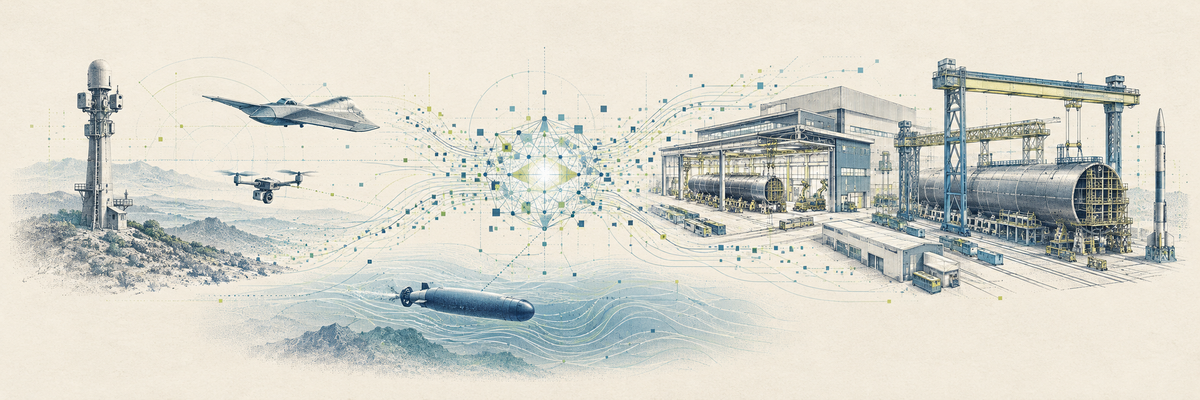
From Autonomy Platform to Defense Production System
Opulentia Research · Valkyrie
Anduril is no longer adequately described as a defense software company that also builds hardware. Its operating model now spans command-and-control software, autonomous aircraft, counter-drone systems, undersea vehicles, electronic warfare, solid rocket motors, soldier systems, and, increasingly, the industrial capacity to produce those systems at scale. The company’s October 2026 announcement of Arsenal-2, a privately financed shipyard designed to manufacture large assemblies for Virginia-class submarines, marks the clearest expansion of that ambition to date.
This report evaluates Anduril as a company and as a test of a broader institutional proposition: whether private capital, product-led development, modular software, and flexible factories can supplement the traditional prime-contractor system without inheriting the same schedule, integration, and cost problems.
Table of Contents
Executive Findings
Anduril has moved from product challenger to emerging systems-and-production company. Lattice remains the connective layer, but recent awards increasingly involve operational command-and-control, serial aircraft production, installation-scale counter-UAS, soldier systems, and submarine manufacturing—not isolated prototypes.
Arsenal-2 is a more important strategic development than its $6.6 billion headline implies. Anduril plans to invest $3.7 billion in a more than two-million-square-foot Maryland facility, while the Navy contract provides up to $2.9 billion through payments tied to demonstrated production outcomes. The structure shifts meaningful execution risk to Anduril and tests whether its manufacturing model works in nuclear-submarine supply chains, where certification, quality assurance, workforce development, and schedule discipline matter as much as software.
Contract values require disciplined interpretation. The Army’s ten-year enterprise agreement has a maximum potential value of $20 billion, but the Army explicitly states that it is not obligated. By contrast, the October 2026 NGC2 award identifies a $162.8 million initial base period and options that could increase total value to $1.8 billion over five years.
The financial profile combines exceptional reported growth with exceptional capital consumption. Third-party reporting places revenue near $500 million in 2023, $1 billion in 2024, and $2.2 billion in 2025, with a company or investor projection of approximately $4.3 billion in 2026. The same report estimates an operating loss of more than $800 million in 2025 and about $1.2 billion in 2026. Because Anduril is private, these figures are not equivalent to audited public-company disclosures.
Access to capital is part of the operating model, not merely a valuation story. Anduril raised $5 billion in May 2026 at a $61 billion valuation to fund manufacturing, R&D, and deployment infrastructure. That financing followed a $2.5 billion round in June 2025 at a $30.5 billion valuation.
The central uncertainty is no longer whether Anduril can win attention or capital. It is whether the company can convert broad contract vehicles, prototypes, and factory commitments into sustained production, accepted systems, repeat orders, and improving economics across several very different industrial domains.
Evidence Guide
Private-company research can create false precision when reported estimates, contract ceilings, forecasts, and company claims are presented as equivalent facts. This report uses the following labels throughout.
| Label | Meaning |
|---|---|
| Confirmed | Disclosed by a government body, contractual notice, corroborated company announcement, or completed financing documentation. |
| Company-reported | Stated by Anduril but not independently audited or fully disclosed. |
| Press-reported estimate | Reported by credible media or research platforms using sources not available for independent inspection. |
| Contract ceiling | Maximum ordering authority, not committed revenue, backlog, or obligated funding. |
| Forecast | A forward estimate that depends on future performance and assumptions. |
| Opulentia calculation | Derived from disclosed or reported inputs, not company guidance. |
| Unresolved | Conflicting public information or insufficient evidence for a definitive conclusion. |
This distinction is especially important for headcount, revenue, losses, contract values, production capacity, and prospective financing.
Company snapshot
Anduril at industrial scale
A software-defined defense company expanding into serial aircraft, counter-UAS, undersea systems, propulsion and submarine manufacturing.
May 2026
May 2026
Press estimate
Forecast
Ceiling, not obligation
Targeted opening
The snapshot is deliberately heterogeneous. Valuation is a completed transaction, revenue and losses are reported estimates, workforce is based on modeled datasets, and large contract values often represent ceilings rather than booked economics.
Industry Context
The traditional U.S. defense-prime model evolved around government-defined requirements, long development timelines, extensive certification, and contracting structures that can reimburse allowable costs. That model suits complex systems whose technical and political requirements change over decades, but it can also diffuse accountability for time and cost.
The emerging neo-prime model shifts part of that risk back to the company. Firms self-fund products before a formal program exists, use venture or growth capital to carry development and manufacturing costs, emphasize modular software, and attempt to sell a repeatable product rather than a bespoke engineering effort.
Anduril is the most expansive U.S. example, though it increasingly works with legacy primes, government laboratories, and other venture-backed companies rather than replacing the old system outright.
Evaluation Framework
A company in this category can be evaluated through six questions:
Demand conversion: Do prototypes and ceiling vehicles convert into funded production orders and repeat deployments?
Risk allocation: Who carries development, cost-overrun, inventory, and facility-utilization risk?
Integration depth: Is the company supplying a component, an autonomy layer, a command system, or an entire mission architecture?
Manufacturing evidence: Can the company meet military quality, certification, sustainment, and delivery requirements at the promised rate?
Capital durability: Can private capital continue funding the interval between product investment and government payment?
Institutional adaptability: Can acquisition organizations absorb commercial iteration without recreating bespoke requirements and incumbent timelines?
Anduril now provides evidence on all six. It has also made the framework harder to apply because it is simultaneously a software platform, product manufacturer, acquisition integrator, and industrial-capacity builder.
Origins and Operating Logic
Anduril was founded in 2017 by Palmer Luckey, Brian Schimpf, Trae Stephens, Matt Grimm, and Joseph Chen. Its original insight was not simply that defense systems needed more AI, but that a defense company could build products before receiving a fully specified government requirement.
Its earliest visible product was a network of autonomous surveillance towers. Over time, the company expanded both organically and through acquisitions into undersea vehicles, tube-launched aircraft, solid rocket motors, and high-performance aircraft.
The expansion suggests a consistent logic: assembling sensing, autonomy, communications, effects, propulsion, and production capabilities around a common integration layer.
Leadership and Organization
| Role | Executive | Research Relevance |
|---|---|---|
| Chief Executive Officer | Brian Schimpf | Responsible for translating a product-led model into multi-program execution. |
| Executive Chairman | Trae Stephens | Connects company strategy, policy, capital, and acquisition relationships. |
| Founder | Palmer Luckey | Represents hardware product vision and public advocacy. |
| Chief Operating Officer | Matt Grimm | Oversees manufacturing, facilities, supply chain, production, and sustainment. |
| President and Chief Business Officer | Matthew Steckman | Leads customer development and expansion across programs and geographies. |
| Chief Strategy Officer | Christian Brose | Shapes the company’s broader neo-prime narrative. |
Product Map
| Domain | Products and Programs | Analytical Significance |
|---|---|---|
| Command and control | Lattice, NGC2 common data layer, Battle Manager | Tests whether Anduril can become infrastructure rather than an application vendor. |
| Air autonomy | Ghost, ALTIUS, YFQ-44A/Fury | Extends the model into high-performance aircraft and serial production. |
| Counter-UAS and air defense | Sentry, Wisp, Pulsar, Roadrunner | Integrates sensing, command, electronic warfare, and kinetic effects. |
| Maritime and undersea | Dive-LD, Ghost Shark, Copperhead | Expands autonomy into long-endurance and contested undersea missions. |
| Strike and propulsion | Barracuda, solid rocket motors | Adds munitions and energetics. |
| Soldier systems | EagleEye and SBMC-related work | Exposes the company to human factors and IVAS-adjacent program risk. |
| Space sensing | Space-domain awareness capabilities | Extends the sensing and tracking layer beyond terrestrial and maritime domains. |
| Industrial software | Arsenal production system and ArsenalOS concepts | Attempts to make factory configuration and workflow part of the company’s advantage. |
Leadership continuity has been an advantage as the company has expanded. The more consequential organizational question is whether centralized product culture can scale across aircraft, missiles, undersea systems, soldier equipment, electronic warfare, software, and submarine components—domains with different regulators, customer organizations, production systems, and failure modes.
Lattice and the Portfolio
Lattice is Anduril’s command, data, and autonomy platform. It connects sensors, vehicles, applications, data, AI models, and effectors so that operators can build a common operational picture and coordinate actions across heterogeneous systems. In the Army’s NGC2 effort, Anduril says Lattice provides a distributed data layer that connects applications, sensors, vehicles, models, and other battlefield systems.
Calling Lattice a “defense operating system” is useful shorthand but analytically incomplete. An operating system implies control over standards, interfaces, developer participation, and distribution. In practice, Lattice competes and cooperates with government-owned architectures, other vendors’ autonomy software, and program-specific interfaces. The February 2026 flight of the YFQ-44A, using both Anduril’s Lattice and Shield AI’s Hivemind on one sortie, suggests future architectures may be modular and multi-vendor rather than controlled by a single platform.
Portfolio architecture
Lattice is the connective layer—not the entire portfolio
Anduril’s strategic claim is that common command, data and autonomy software can coordinate products across otherwise distinct industrial domains.
The portfolio breadth matters because cross-domain integration may improve customer relevance and increase reuse of software, autonomy, supply chain, and business-development capabilities. It also creates the possibility that Anduril becomes an aggregation of capital-intensive product lines whose common software layer does not produce the economics implied by the platform narrative.
Capital Formation
Anduril’s financing history matters less as an investment story than as evidence of the capital required to self-fund defense products and industrial capacity before government demand is fully obligated.
Capital formation
Private capital became production infrastructure
Financing expanded from venture rounds into multi-billion-dollar commitments capable of carrying factories, inventory and long program cycles.
Seed~$17.5M
~$88M valuation*
Series C$200M
$1.9B valuation
Series E$1.48B
~$8.5B valuation
Series F$1.5B
$14B valuation
Series G$2.5B
$30.5B valuation
Series H$5B
$61B valuation
Crunchbase placed cumulative funding at about $11.4 billion after Series H, while other databases report totals closer to $12 billion, depending on round extensions, grants, and how transactions are treated. A narrow point estimate therefore communicates more certainty than the public record supports.
At the $61 billion primary valuation, the company was valued at approximately 27.7 times reported 2025 revenue of $2.2 billion and approximately 14.2 times the $4.3 billion 2026 forecast. These are Opulentia calculations based on reported inputs, not audited results or a valuation recommendation.
The operational implication is more important than the multiple. A company that finances factories, inventory, engineering, and acquisition integration before production revenue arrives needs unusually durable access to capital. The May 2026 round was explicitly framed as funding manufacturing capacity, R&D, and infrastructure for fielding systems at scale.
Financial Profile
Reported financial trajectory
Revenue has scaled faster than the cost base
Reported revenue rose from roughly $0.5 billion in 2023 to $2.2 billion in 2025. The 2026 figure is a forecast, not an audited result.
If the 2026 forecast is achieved, reported revenue would have increased more than eightfold since 2023. That trajectory is unusual in defense, where production ramps and budget cycles normally constrain acceleration. It also makes revenue composition important: prototype work, reimbursed development, software, hardware delivery, sustainment, and manufacturing services do not carry identical margins or repeatability.
Public reporting indicates that Anduril is spending ahead of revenue to finance factories and product development. The result is not simply “growth at a loss” in the software-company sense. Industrial expansion ties cash to facilities, tooling, certification, suppliers, work in process, and labor before completed systems generate payment.
Because the company does not publish audited segment reporting, several questions remain unanswered:
- How much revenue comes from Lattice software versus hardware, integration, development, and sustainment?
- What portion of gross profit is generated by mature products versus early programs?
- How concentrated is revenue across the largest government customers and programs?
- How much working capital is required as aircraft, munitions, and submarine work scale?
- Do program-level margins improve after production stabilizes, or does portfolio complexity offset scale benefits?
The absence of these disclosures does not prove poor economics; it limits what external research can conclude.
Contract Architecture
Large defense awards are often reported as if every headline value were backlog. The table below separates prototype awards, base funding, options, ceilings, and production-linked structures.
Headline value is not one kind of value
The most useful distinction is between obligated base funding, exercisable options, program frameworks and ceiling vehicles.
Selected programs
From prototype awards to production systems
A responsive table separating announced value from contract structure and unresolved execution questions.
| Program | Announced value | Structure | Primary uncertainty |
|---|---|---|---|
| Army enterprise | Up to $20B | Ceiling vehicle | Task-order timing and volume |
| NGC2 fielding | $162.8M base; up to $1.8B | Base plus options | Option exercise and field performance |
| USMC counter-UAS | $642M | 10-year program of record | Annual ordering and deployment results |
| Soldier Borne Mission Command | $159M | Rapid prototype; competitive | Selection and fielding scale |
| Arsenal-2 | Up to $2.9B | Production-outcome payments | Milestones, qualification and utilization |
Values should not be summed as backlog.
The contract mix suggests Anduril is moving from isolated prototype awards toward a portfolio that includes programs of record, production contracts, enterprise ordering vehicles, and operational software fielding. At the same time, ceiling values should not be treated as revenue or backlog.
Manufacturing system
Two arsenals, two different execution tests
Arsenal-1 tests flexible serial production across product families. Arsenal-2 extends the thesis into nuclear-submarine supply chains.
Arsenal-1 · Ohio
Flexible autonomous-systems production
- Private investment
- >$900M planned
- Footprint
- Up to 5M sq. ft.
- Jobs
- >4,000 planned
- Test
- Rate, changeover and utilization
Arsenal-2 · Maryland
Virginia-class submarine components
- Private investment
- $3.7B planned
- Navy contract
- Up to $2.9B
- Footprint
- >2M sq. ft.
- Target
- Initial operations in 2030
Arsenal-2 payments are tied to demonstrated production outcomes, shifting meaningful execution and utilization risk to Anduril.
Why Arsenal-2 Changes the Analysis
Arsenal-2 is not merely a larger factory. It changes five elements of Anduril’s risk profile:
Time horizon: Initial operations aren't expected until 2030, creating a long gap between capital commitment and scaled output.
Certification burden: Nuclear-submarine components require exacting materials, welding, documentation, inspection, security, and supplier qualification.
Workforce formation: More than 3,100 permanent jobs require recruiting and training a skilled industrial workforce while rebuilding shipbuilding capability at the site.
Incumbent dependence: Anduril adds capacity but remains integrated into Electric Boat and Newport News final assembly.
Outcome-linked economics: Payments tied to demonstrated production outcomes align public spending with delivery but leave the company carrying substantial execution and utilization risk.
The facility will not solve the Navy’s immediate submarine backlog because it won't start until 2030. Its significance lies in adding parallel industrial capacity over the next decade and testing whether private capital can enter a segment historically dominated by a small number of government-dependent yards and suppliers.
Competitive Landscape
No single company matches Anduril’s exact portfolio. The relevant competitive set changes by layer, with Shield AI, Saronic, Helsing, General Atomics, and legacy primes each occupying different parts of the autonomy, production, and defense-industrial stack.
| Company | Primary Strength | Relationship to Anduril |
|---|---|---|
| Shield AI | Mission autonomy and aircraft systems | Competitor and autonomy partner in some contexts. |
| Helsing | European sovereign defense AI | Competitor in allied AI and autonomy markets. |
| Saronic | Autonomous surface vessels and maritime production | Competitor in maritime autonomy and industrial-capacity narrative. |
| General Atomics | Mature unmanned-aircraft production | Direct CCA competitor and production benchmark. |
| Legacy primes | Certification, sustainment, installed capacity, customer access | Competitors, partners, customers, and final integrators depending on program. |
Capital is converging on a small number of defense-technology leaders. Shield AI’s 2026 financing combined equity, preferred capital, and a delayed-draw facility; Saronic’s round aimed to expand maritime production; and Helsing’s financing supported a shift from AI software to autonomous strike and surveillance systems. This suggests the neo-prime category is becoming more industrial and capital-intensive, not less.
Anduril’s advantage is its breadth and the potential to reuse software across domains. Its disadvantage is that this breadth increases the number of programs, factories, certification regimes, and partner interfaces that management must run simultaneously.
Business Model
- Software and data-integration work through Lattice and command-and-control programs.
- Hardware sales and production contracts for aircraft, sensors, counter-UAS systems, undersea vehicles, missiles, and other systems.
- Prototype and development awards that may or may not convert into production.
- Sustainment, integration, training, upgrades, and field support.
- Industrial production of components for other prime contractors, as planned at Arsenal-2.
The company’s self-funded product development changes bargaining dynamics. A completed or mature product may reduce government development risk and enable faster evaluation, but it also forces Anduril to carry more pre-contract spending and anticipate demand accurately enough to avoid building capacity that fails to secure durable orders.
Strategy and Culture
Anduril’s culture is designed around speed, technical ownership, and willingness to take commercial risk before requirements are settled. That posture helps explain why it can field prototypes quickly and recruit employees who want responsibility closer to the product than a traditional matrixed program may offer.
The same culture faces a different test at industrial scale. Submarine components, aircraft production, energetics, and soldier-worn systems require configuration control, traceability, safety processes, and disciplined test evidence.
Risk Analysis
- Production and schedule risk across several factories and product families.
- Contract-conversion risk, especially where ceilings are mistaken for backlog.
- Capital-intensity risk from scaling ahead of stabilized production.
- Program-transition risk as requirements and funding evolve.
- Customer and policy concentration risk.
- Autonomy-governance risk as software takes on operational roles.
- Workforce and quality risk in highly regulated industrial domains.
- Portfolio-complexity risk if breadth overwhelms platform leverage.
Evidence to Watch
What would change the assessment?
Operational evidence is now more informative than another valuation or contract-ceiling announcement.
- 01Funded conversionDemand
Task orders, obligated dollars and repeat purchases under the Army enterprise vehicle.
- 02FQ-44 productionAir
Aircraft delivered and accepted, production rate, readiness and future CCA position.
- 03Arsenal-1 utilizationFactory
Activated lines, output by product family, changeover time and delivery performance.
- 04Arsenal-2 milestonesIndustrial
Qualification, workforce training, milestone payments and accepted submarine components.
- 05Financial qualityEconomics
Revenue mix, gross margin, cash consumption, working capital and sustainment share.
- 06Platform opennessSoftware
Third-party integrations, interface control and evidence that Lattice reduces lock-in.
Adapted from the report’s “Evidence to Watch” framework.
Assessment
Anduril has already demonstrated three capabilities that distinguish it from most defense startups: it can raise capital at industrial scale, win increasingly consequential government work, and expand from a software-centered architecture into multiple hardware domains.
The evidence therefore suggests that Anduril’s software-defined, venture-backed model can reach industrial scale. It does not yet show that the company can deliver certified output across multiple industrial domains on predictable schedules and with durable economics.
Arsenal-2 raises the level of difficulty. Building submarine components is not a natural extension of shipping software more frequently; it is an entry into one of the defense economy's most demanding certified production systems.
The next phase will be measured less by announcements and more by delivery: funded orders rather than ceilings, accepted systems rather than prototypes, production rates rather than factory footprints, and cash conversion rather than valuation.
Methodology
This report synthesizes public government disclosures, congressional research, company announcements, completed financing documentation, state economic-development releases, and third-party reporting available through October 9, 2026.
Where sources disagree, the report presents ranges or identifies the discrepancy rather than selecting a falsely precise figure. Contract ceilings are not treated as backlog or revenue, and forecasts are labeled as forecasts.
The report does not use confidential company information, board materials, or non-public Opulentia diligence.
Important Disclosures
This publication is provided by Opulentia Ventures and/or its affiliates for general informational and educational purposes only. It is not investment, legal, tax, accounting, or other professional advice and does not constitute an offer, solicitation, recommendation, endorsement, rating, or prediction regarding any security, company, fund, transaction, or strategy.
The analysis reflects information available as of the stated research cutoff and may change without notice. Forward-looking statements, including production targets, facility plans, revenue forecasts, contract options, economic-impact estimates, and anticipated program outcomes, are uncertain, and actual results may differ materially.
Information was obtained from public and third-party sources believed to be reliable, but Opulentia does not represent that every item is complete, accurate, or current.
Opulentia Ventures, its affiliates, and affiliated investment vehicles hold financial interests in Anduril acquired through multiple financing rounds. This creates a potential conflict of interest. The research and conclusions presented here were developed independently and are provided solely for informational purposes; they do not constitute investment advice, an offer, or a solicitation.
About Opulentia Research
Opulentia Research examines companies, technologies, markets, and strategic trends shaping national security, critical infrastructure, artificial intelligence, health, space, and other emerging domains. Its purpose is to develop independent, evidence-led perspectives rather than publish transaction marketing or convert prior investment decisions into predetermined conclusions.
About Opulentia Ventures
Opulentia Ventures operates as a “VC Tribe” consolidating resources from experienced investors to support pioneering companies advancing technology, healthcare, and national security. Headquartered in the Washington, DC, metro area, the firm leverages deep government and defense-sector relationships to identify emerging opportunities at the intersection of innovation and national priorities. Opulentia’s investment architecture is organized into four domain-focused pillars: Valkyrie, backing defense technology and dual-use systems that strengthen deterrence and operational advantage; Cipher, targeting deep tech innovations in AI, quantum, and critical infrastructure; Panacea, investing in health technology and life sciences that improve care delivery and population resilience; and Aether, focused on space and energy platforms building the next generation of orbital and terrestrial infrastructure.